Saturday, July 29, 2006

剧本,第五部

Non-rigorous English translation available below.

序幕
第一幕
第二幕
第三幕


第四幕

(A)
人物:Vivian,陈一维
场景:某餐厅里
语文:普通话

(晚还早,餐馆里只有两桌的客人。陈一维在bar里的洗碗盆边洗杯子。)

(厨房的双门打开,Vivian出现。她在角落停了一会,仔细地观察工作时间表。之后顺手拿起了自己的杯子,喝了两小口的茶,再把杯子放下。)

Vivian:(转向陈一维)阿Tan,你是喜欢男的或是喜欢女的?
陈一维:(马上抬起头望着Vivian,停止洗杯)哈?当然是女的啦!
Vivian:哦。。。
陈一维:你为什么又会问到这点?
Vivian:没有啦,因为这边很多男人都是喜欢男的嘛。。。
陈一维:哎,虽然是多选择,但是(厨房里的铃响了一声,Vivian转身准备进厨房拿菜,一面听陈一维的那句,一面向厨房走)我的internal structure就是喜欢女的。
(Vivian开了门,呆在中间。陈一维说完,她就消失如厨房。)

(送出客人的菜时忙了一会,几分钟后才可继续谈。)

陈一维:你为什么刚才会那么干脆地问我那个问题的?
Vivian:不然你要我怎么样问你?
陈一维:啊,也是的。只是没想到有人会问这种那么personal的东西。。。
Vivian:(手拿了桌布准备察桌)但是这边很多gay的男人。你也应该知道吧。。。
陈一维:啊,对。
Vivian:(从bar里拿了察桌的一块布)除了你和余先生,男的全都是gay的。
陈一维:(把手伸到架里拿匙叉和纸巾)是咯,我以前SMS给我的妈妈说这边很多这种人时,她立刻打个电话过来问。我跟她说没有东西的啦。
Vivian:哈哈。

(Vivian走向空桌,陈一维跟在后。她把桌察干净了,就离开。陈一维把纸巾和匙叉摆在桌上。)


(B)

人物:张小姐,陈一维
场景:某咖啡店里
语文:普通话

(张小姐和陈一维坐在一张小圆桌前。桌上摆着一本书,两杯咖啡,一部手机和一个提包。)

陈一维:昨晚Vivian问我喜欢男的或喜欢女的。
张小姐:哈,真的?我没听到的?
陈一维:那时你不在,你好像上了楼上或在厨房里。
张小姐:哦,那你怎么回答?
陈一维:我说,当然是喜欢男的啦!
陈一维:我的样子很gay吗?。。。
张小姐:(急着插了嘴)你等下。你刚才说什么?
陈一维:哦,我说,我的样子很gay吗?
张小姐:(把手指转了半圈,表示‘退回去’)不是,再前一句。
陈一维:哪一句?啊,我说我是。。。哦,我跟你讲错了。但是我跟Vivian说的是对的。
张小姐:我给你吓了一跳。。。

(第四幕终)


***


Act 4

(A)

Characters: Vivian, Yee Wei
Scene: a restaurant
Language: Chinese/ Mandarin

(It was still early, and only two tables were occupied by customers. Yee Wei washes glasses in the bar’s sink.)

(The kitchen’s double doors open, and Vivian appears. She stops at a corner for a while, scrutinising the shift timetable. She picks up her glass, takes two sips of tea, and puts the glass down.)

Vivian: (faces Yee Wei) Tan, do you like guys or girls?
Yee Wei: (raises his head to look at Vivian, stops washing glasses) Huh? Of course I like girls!
Vivian: Oh…
Yee Wei: Why do you ask?
Vivian: Nothing; a lot of guys here prefer males…
Yee Wei: Aih, there may be more choices for me, but (a bell rings in the kitchen, Vivian turns towards the kitchen, listening to Yee Wei speak while making her way to the kitchen) my internal structure is such that I like females.

(Vivian opens the kitchen doors, and waits at the doorway. When Yee Wei finishes speaking, she disappears into the kitchen.)
(They busy over the delivery of dishes for some minutes, before resuming their conversation.)

Yee Wei: Why did you ask that question so bluntly?
Vivian: And how else should I ask?
Yee Wei: Yes, very true…
Vivian: Apart from you and Mr Yu, the guys here are all gay.
Yee Wei: (reaches into a rack to get some cutlery and napkins) Yea, when I texted my mother telling her that many people here are of this sort, she immediately phoned me. I had to reassure her it’s ok.
Vivian: Haha.

(Vivian moves towards an empty table, Yee Wei follows behind. She wipes the tabletop clean, and departs. Yee Wei arranges the napkins and cutlery on the table.)


(B)

Characters: Tracy, Yee Wei
Language: Chinese/ Mandarin

Yee Wei: Yesterday, Vivian asked me if I like guys or girls.
Tracy: Oh, really? I did not hear that.
Yee Wei: You were not there; I think you were upstairs or in the kitchen.
Tracy: Oh… so how did you reply?
Yee Wei: I said, of course I like guyss!
Yee Wei: Do I really look that gay?...
Tracy: (interrupts hastily) Wait, what did you say?
Yee Wei: Ah, I asked if I really look that gay.
Tracy: (twirls index finger in the air drawing semicircles, indicating ‘one step back’) No, before that.
Yee Wei: Which sentence? Ah, I said I perfe… Oh, I made a mistake. But I told Vivian the correct details.
Tracy: Ah, that gave me a shock…

(End Act 4)


Labels: , ,

Friday, June 09, 2006

剧本,第四部

两天前,小李飞刀发了一封电邮过来,问那“romantic saga”的刷本何时才有下一部。

我不很喜欢把自己的感情透露给全世界看(也不是说有数百人来读我的文章),就估计刷本应该没再写下去了。

正巧今天有些出奇的事件发生,所以刷本又加上了一幕。也刚好这件事不会把自己显露了太多。

序幕
第一幕
第二幕


***


第三幕
人物:余先生,张小姐,老板,陈一维,餐馆客人
场景:某餐管里
语文:普通话

(余先生从前门入餐馆,走到后面去拿饭。经过在擦干匙叉的陈一维时停下打招呼。)

陈一维:老余,你好!好久没见了。
余先生:(用手拍了陈一维的背两下)你好,阿Tan。
陈一维:吃饭吃饭。我们都吃饱了。
余先生:好,好。


(余先生吃了晚饭后,餐馆也开了不久,暂时只有一桌坐了客。老板在店前的柜台接了电话,张小姐在给顾客点菜,余先生在准备饮品给客人,陈一维在bar里把中午洗干净的杯子摆回原位。)

(余先生把可乐和啤酒送到台,便走回到bar和陈一维谈天。)

[ 余先生说话有上海口音,听不惯的人总是听不清楚。而且说话说得很快,句子在脑里还没造完就开始讲了,造成有些是听起来如口吃。]


余先生:你,你和[ 她 ]怎么了?
陈一维:没什么啊。
余先生:啊?!一点发展都没有?
陈一维:那就有。没那么慢吧。
余先生:好好,约了她出去吗?
陈一维:也有啊,去喝茶等。都几次了。
余先生:有牵手了吗?
陈一维:(吃了一惊,目瞪口呆了一会儿)
陈一维:(笑着说)哪里有这么快!
余先生:太慢了。你太慢了。
陈一维:不会啦,这么急干嘛。

(第三幕终)


Labels: , ,

Thursday, May 18, 2006

Stuff of (impermanant) dreams

That Lotus Elise is getting more attractive by the day. Or rather, I'm allowing myself to be more attached to that Lotus Elise.

In Europe of the 18th century, Immanuel Kant noted that a person is only truly free if he/she acts independently of desires, ego, social expectations and self interest. In the words of Sophie and Alberto Knox in Sophie's World (Gaarder, Jostein; London; 1995):
“So when you choose not to be mean – even if it’s against your own interests – you are then acting freely.”
“You’re not especially free or independent if you just do what you want, in any case.”
“One can become a slave to all kinds of things. One can even become a slave to one’s own egoism. Independence and freedom are exactly what are required to rise above one’s desire and wishes.”

By the way, to the uninitiated, this Lotus Elise is a metaphor for an attachment of mine. It is yellow in colour.

On the issue of cars, I saw a particularly interesting Audi yesterday afternoon while waiting for the tram. It was an RS4. It sounded absolutely magnificent even when puttering along. Even better, I think, than the Mercedes E55 AMG. Yes, I’ve heard that car too.

Now, if you’d excuse me, I need to work on my Chinese.

A mathematics or applied science post tomorrow. Promise.


Labels: , ,

Friday, May 12, 2006

剧本,第三部

No English translation below; don’t bother scrolling.

序幕
第一幕


***


第二幕

旁白:想回几天前的事。。。


(A)
人物:余先生,陈一维
场景:某间餐馆内
语文:普通话

(时间不早了,还逗留着的客人都已吃完了晚餐在聊天。两位服务员都下班了,只剩下余先生和陈一维与老伴管理餐厅。)

(服务员们用的厨上见一个小布袋,看起来如装手提电话的袋子。)

陈一维:(拿起布袋研究)这个是谁的你知道吗?
余先生:一定是[ 她 ]的。男人不会用这种东西的啊。
陈一维:(把布袋放下)对对。。。
余先生:你喜欢她吗?
陈一维:谁?
余先生:[ 她 ]。
陈一维:(慢言)怎么说喜欢?
余先生:你喜欢不喜欢她?
陈一维:(静一会儿)有点咯。
余先生:(微笑)啊,好了好了。
余先生:[ 她 ]人性很好的。也很有气质。
陈一维:什么气质?
余先生:就是他的态度,很有好感,怎么说。。。
陈一维:(从bar拿了一支笔和一小张纸)是不是这么写?(在纸上猜写了“气子”两个字。)
余先生:不是不是,来来我写给你。(拿了笔,在纸上写了“气质”两个字。)
陈一维:啊,谢谢。
余先生:你有她的电话号码吗?
陈一维:没有。
余先生:跟他拿了吧!
陈一维:呵呵。。。
余先生:你就加油啦!


旁白:回到目前来。。。

(B)
人物:余先生,Tracey,陈一维
场景:某间餐馆内
语文:普通话

(一维在bar内洗杯子。余先生来准备饮品给客人。)

余先生:你有了[ 她 ]的电话号码吗?
陈一维:前几天都没见到她。
余先生:哦。我有她的号码,但是你自己跟她那好了。我给你,就不好了。
陈一维:对,很。。。(在脑海中找着对的词)很鬼祟。
余先生:找一天约她出去吃晚餐啦。或者去喝杯咖啡也好。
陈一维:(没出声)
余先生:(准备好了饮品)她也应感觉到了。她很聪明的,一定会知道。
余先生:(转身离开bar)你加油。
陈一维:哈,谢谢你的鼓励。

Tracey:你近来有忙着什么东西吗?
陈一维:没有什么。学着读华文咯,还是很辛苦,慢得要死!而且是儿童书呢!
Tracey:(吃惊)你干吗要现在学读华文?会讲就行了嘛!
陈一维:不能,我的华文还是很差。连讲的vocabulary都不很好。
Tracey:哦。。。
陈一维:Vocabulary怎么说?
Tracey:词汇。
Tracey:我明白你的意思了。

Labels: , ,

Sunday, April 30, 2006

Screenplay, part 2

Sort of a continuation from the Prologue (no English translation for the prologue).

English translation provided at the end of the Chinese text. The screenplay format was used as it would allow a decent level of detail to be conveyed without having to resort to fanciful sentence crafting. Anyway, I am unable to produce decent Chinese sentences. Give me time. Lots of time.

Note to Mr. Hon SY: I doubt you’d want to watch this performance on stage- it’s probably too dull. You want sex, drugs and violence, not small talk about today’s weather.


***


第一幕
人物:陈一维,林小姐,老板
场景:某餐厅之bar
语文:普通话

(餐馆以关了,只剩三人打扫与准备给明天中午开门。林小姐在bar里的洗碗盆洗杯和茶壶、一维从厨房的大冰橱拿各种饮品填满bar的冰橱、老板在整理餐厅的桌。)

林小姐:老板,你须不须要请新的工人?
老板:为什么呢?
林小姐:我有一个朋友找着part time工作。
老板:(走到bar前根林小姐谈)哦,这样。他有做过的吗?
林小姐:没有。
老板:没有experience怎么做?
林小姐:可以学的吗。怎么样都一定比那个沙发好啦。你知道吗,刚才她多么过分。这里有一大堆杯,她都没有来帮洗,还在那边(指着餐厅里的走廊)走上走下不知干吗。

(老板没出声。)

一维:(蹲在bar里的冰箱旁排饮品的罐和瓶子)可以啦,没有经验还可学的。
林小姐:对呀。你看一维也做得很好吗。
老板:(对一维)阿陈,你以前在那里工作?
一维:(停止填冰橱,转向老板)什么工作?
老板:做hospitality的工作啊。
一维:我没有做过的。这是第一次。
老板:(吃一经。大马音调强)哈?你以前不是更我讲你有做过?
一维:(笨笨的微笑)哦。。。没有办法啦,要找一个开始。
老板:(大马音调强)哎呀,你骗我啊?要跟你罚款五块钱的啦。。。

(林小姐小声的笑。)

(老板走开打扫餐厅、一维继续填饮品、林小姐洗杯。)

(第一幕终)


***


Act 1
Characters: Tan Yee Wei, Miss Lim, Boss
Scene: the bar of a restaurant
Language: Chinese/Mandarin

(The restaurant has closed for the day, and only three people remain to tidy up and prepare for the next business day’s lunch opening. At the bar’s washing sink, Miss Lim washes used glasses and tea pots. Yee Wei is bringing various bottles and cans of drinks from the large fridge in the kitchen to restock the bar. Boss is tidying the dining area.)

Miss Lim: Boss, do you need new workers?
Boss: Why do you ask?
Miss Lim: I’ve got a friend who is looking for a part time job.
Boss: (walks to the bar to talk to Miss Lim) Ah, I see. Any working experience?
Miss Lim: No.
Boss: How will she work without experience?
Miss Lim: She can learn on the job. It will be better than that Sofa anyway. You know, she was really overdoing it earlier this evening. There was a huge pile of dirty glasses here, and she did not come help do them, and was walking up and down there (points to the aisle in the dining area) doing nothing.

(Boss keeps quiet.)

Yee Wei: (squatting next to the bar’s fridge arranging bottles and cans of drinks.) It’s doable, she can learn even if she hasn’t got experience.
Miss Lim: Yeah. Look, Yee Wei is also doing quite well.
Boss: (to Yee Wei) Tan, where did you work previously?
Yee Wei: (pauses stocking the bar, faces Boss) What work?
Boss: Your previous job in hospitality.
Yee Wei: I haven’t worked before. This is my first time.
Boss: (Surprised. Speaks with thick Malaysia Chinese accent) What? Didn’t you tell me when you came in you’ve got experience?
Yee Wei: (smiles sheepishly) Ah yes…I had no choice. Had to start somewhere…
Boss: (speaks with thick Malaysian Chinese accent) Aiyah, you lied to me? I must give you a fine of $5…

(Miss Lim laughs quietly)

(Boss returns to tidying the dining area, Yee Wei continues stocking the fridge, Miss Lim washes the remaining glasses.)


(End Act 1)


***


Appended 2200 1/5/06:

As the cliché goes, an idle mind is the devil’s workshop. As much as I dislike clichés, Mr Hon is one perfect example of this. The following plot is written by him, slightly edited for consistency with the original settings.

This section was not written by me, and is not based on true events.

(一维和林小姐在bar内工作。)
林小姐:一维,你说老板会请我朋友吗?他可是蛮需要找份工的。。
一维:你可以叫你朋友也骗骗老板嘛,说自己有experience。 你看,老板也不会很生气的。
林小姐:你都骗过一次啦,哪能用一样借口俩次的?(埋怨的眼神)
一维:嗯。。。那是因为你诚实嘛。。你是个。。乖女孩。。
林小姐:(甜蜜的笑容)是吗?可没人说过我乖呢!我看你样子都挺诚实的,真没想到你会骗人。你会不会也在骗我呢?
一维:当然不会!我跟你讲话一定很诚实的。
林小姐:哈哈。。咦?你干嘛脸都红啦?
一维:我,我。。。
(老板走到bar前)
老板:喂,你们做东西做得那慢啊?


(Yee Wei and Miss Lim work on their tasks in the bar.)
Miss Lim: Yee Wei, do you think Boss will hire my friend? She needs a job quite badly…
Yee Wei: You could ask her to lie to the Boss and say she has worked before. Look, he didn’t get too annoyed earlier anyway.
Miss Lim: (complainingly) You’ve already lied once, how can the same line be used again?
Yee Wei: Err, that’s because you are honest. You are a… good girl.
Miss Lim: (smiles sweetly) Really? No one told me that before! You look like a honest and morally integral person, who would’ve thought you’d tell lies. Are you bluffing me now?
Yee Wei: Of course not! I will always tell you the truth.
Miss Lim: Haha… Eh? Why are you blushing?
Yee Wei: I…
(Boss walks towards the bar)
Yee Wei: Hoi, why are you two taking so long to finish up?

Reminder: this section was not written by me, and is not based on true events.


Labels: , ,

Friday, April 21, 2006

Stuff of (impermanant) dreams

For several years already, I have been adhering to the ‘no attachments’ school of thought for certain aspects of my life.
If one binds one’s ego to an impermanent characteristic/object, one is bound to be pained when that characteristic/object disappears. Which is bound to happen, seeing that it is impermanent in the first place.

However, it could well be a case of rationalising my failure to achieve much in those aspects of my life. In other words, sour grapes.


***


“Nay, there is no point to owning a car. Look at the price cars are selling for these days! And think of the petrol prices, maintenance costs, parking fees and taxes. Insurance!”

“I’d rather live without a car- one less attachment to fret over.”

Then along comes this bright yellow race-spec Lotus Elise. Wrapped around the circumference of its magnificent BBS rims are Yokohama sports tyres, with barely a few treads just to get around the regulations. A black wing stretches across the car’s rear, and a carbon fibre diffuser is in place of the original aluminium underbody panels. An uprated engine block, racing gearbox and limited slip differential justifies the aerodynamics and suspension upgrades.

The Lotus idles noisily, occasionally burping and popping loudly through its unsilenced exhaust pipes. Abruptly, it accelerates brutally down the main straight, the waste gates hissing angrily at each gear change. It brakes and downshifts into turn one, flames crackling from the exhaust. Through the apex the car sweeps, accelerating out with a menacing wail.

“I think I’d like a car like that…”
That grape might not be so sour after all...

Little did I know that a car like that is a humongous hassle. The gearbox is not synchromeshed, demanding perfect shifts every time. The clutch bites like a crocodile’s jaws, with little room for error. The steering geometry does not allow 3-point turns; it advocates 7-point turns. In rain, the slick tyres grip like ice blocks. There is no seat for a passenger, neither is there room for groceries. There is no air-conditioning except for a pipe that funnels air from the front of the car into the driver’s face. There is no insulation, noise or thermal. The suspension feels like they were machined out of solid granite.


***


And I'm not talking about cars; not this time anyway.


Labels: , ,

Saturday, April 15, 2006

Experimental formatting- Chinese screenplay

Edited 4th May 2006: a sloppy English translation has been appended to this post.


序幕
人物:陈一维,Tracey,大厨师,餐厅顾客
场景:某餐厅之bar

(餐厅顾客少。一维在bar内的洗碗盆洗杯子。Tracey在对面与他聊天。)

Tracey:你是从马来西亚来的是吗?
一维:对,靠近首都吉隆坡。那么你呢?
Tracey:我来自中国。
一维:中国哪一部?
Tracey:四川。

(厨房双门打开,大厨师升出上半身。)
大厨师:(对着一维,摆手叫他过去)来,来。有空就教你点东西。

(一维把杯子冲干净,双手抹干,跟大厨师入厨房。Tracey继续洗杯。)

大厨师:现在不忙就可指给你看怎么准备铁板鱿鱼。(拿出个木板, 到火炉,从旁拿一个铁钩,便用钩把炉上烧着的铁盘托到木板上。在铁盘上落些生洋葱,加些食油。从炉上拿起蜗。)如果很忙的话,我就把煮好的料倒在碗里。你要准备铁板然后把料倒上。最后加点酒上去,就好了。

(大厨师把蜗里的鱿鱼倒上铁盘,然后加上米酒。盘里啥了一声。)
(一维从厨房拿出铁板鱿鱼和一盘白饭,摆在客人桌上。)

一维:Your sizzling calamari and a steamed rice.
客人:Looks good. Thank you.
一维:Enjoy your dinner.

(一维回到bar边站。Tracey还洗着杯子。)

Tracey:今天是你第一天在这里工作?
一维:第二天。昨晚我也有来。
Tracey:你以前有在餐馆做过吗?
一维:没有。这是第一次。
Tracey:哦,那么以前做什么种工?
一维:近来都没有做工。
Tracey:(吃一小经,从洗碗盆望上)哇,好幸福呀!
一维:(不知如何回答)Errrr…

(两人静一阵。Tracey洗杯,一维注意着顾客们。)

Tracey:(想想后)读书时不用打工都瞒爽的。。。
一维:那是真的。时间多,压力也少。
Tracey:还可以参入各种学会和活动。
一维:对呀。

(两个客人从前门进入餐馆。)

Tracey:(把头轻轻地向前方点一点)有人到。

(一维拿两本菜板,去欢迎顾客。)

(序幕终)


***


Prologue
Characters: Yee Wei, Tracey, Head Chef, restaurant customers
Scene: A restaurant
Language: Chinese/Mandarin

(There are very few customers in the restaurant. Yee Wei is at the bar’s sink washing some glasses. Tracey stands across the bar.)

Tracey: You are from Malaysia, is that right?
Yee Wei: Yes, close to the capital Kuala Lumpur. Yourself?
Tracey: I’m from China。
Yee Wei: Which part of China?
Tracey: Szechuan.

(The kitchen’s double doors open and the Head Chef leans out.)

Head Chef: (To Yee Wei, waving his hands to invite him over) Come, come. I’ll show you around while we have time.

(Yee Wei finishes cleaning the cup, dries his hands and follows the Head Chef into the kitchen. Tracey takes over washing the remaining cups.)

Head Chef: Now that we’re not busy I’ll show you how to prepare a sizzling calamari dish.

(The Head Chef reaches for a wooden tray, heads towards the gas stoves and grabs an iron hook from a side counter. Using the iron hook, he manipulates the steel dish on the burner and puts it on the wooden tray. He then adds some raw onion pieces, a dash of oil and removes a wok from the main stoves.)

Head Chef: If we’re busy, I will pour the cooked calamari into a bowl here. You’ll have to prepare the hot plate and pour the calamari onto the dish. Finally, add a dash of cooking wine, and off you go.

(The Head Chef pours the calamari into the heated dish, and adds some wine. They make a noisy hiss as each ingredient contacts the hot metal.)
(Yee Wei brings the dish of sizzling calamari and a plate of rice to a customer’s table.)

Yee Wei: Your sizzling calamari and a steamed rice.
Customer: Looks good. Thank you.
Yee Wei: Enjoy your dinner.

(Yee Wei returns to the bar’s side. Tracey is still washing glasses.)

Tracey: Is this your first day here?
Yee Wei: Second day. I worked yesterday night too.
Tracey: I see. Have you worked in any other restaurants in the past?
Yee Wei: No. This is my first.
Tracey: Oh. So what kind of work did you do before?
Yee Wei: I haven’t worked in recent times.
Tracey: (Surprised, and looks up from the glasses) Wow, how fortunate!
Yee Wei: (speechless) Ermm…

(They keep quiet for a while. Tracey continues washing the glasses, Yee Wei keeps an eye on the customers.)

Tracey: (after some contemplation) It must be nice to not have to work while studying…
Yee Wei: That’s true. You have a bit more time and less stress.
Tracey: And you can join the activities of carious clubs and groups too.
Yee Wei: Yup.

(Two new customers enter the restaurant.)

Tracey: (Nodding gently towards the front of the restaurant) Customers.

(Yee Wei grabs two menus and goes forward to greets the new customers.)

(End Prologue)


Labels: , ,

Sunday, March 12, 2006

The JFE 8555 problem revisited- digital roots

Note: Familiarity of the concept of congruence is expected. Failing that, a concise introduction can be found here.

A rethink of the original problem has prompted a much neater (although not necessarily any easier to read) and a more general solution.

We will attempt to add the digits together in any arbitrary manner, repeating till we reach one digit.

35897
-> 3 + 5 + 8 + 9 + 7 = 32
-> 3 + 2 = 5

(35) + (897) = 932
-> 9 + 3 + 2 = 14
-> 1 + 4 = 5

(3+5) + (8 + 9) + 7 = (8) + (17) + 7
-> 8 + (1+7) + 7 = 8 + 8 + 7
-> 8 + 8 + 7 = 23
-> 2 + 3 = 5

3 + 58 + 97 = 158
-> 15 + 8 = 23
-> 2 + 3 = 5

The flabbergasted reader might want to try a few other addition combinations for amazement’s sake, and to show that the result is always 5.


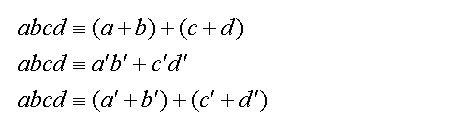
To generalise the situation, the number involved will be written as abcd with each letter representing one digit. This number abcd can be in any base n. For sake of simplicity this number is represented with only 4 digits, but can be extended to as many digits as desired.

Separating the digits of abcd:


Equations (1)


Remember that the notation is generalised for any base-n, hence the powers of n are used instead of thousands, hundreds and tens as used in base-10.


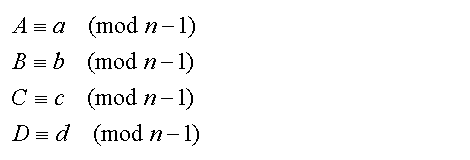
Equations (2)


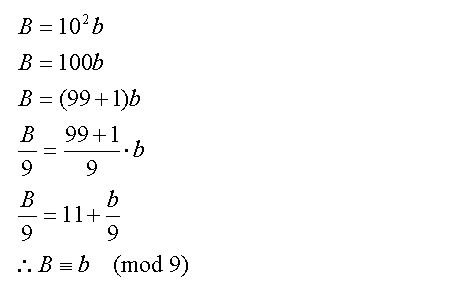
Equations 2 are valid statements. To illustrate, we will use n=10 with B:


Equations (3)


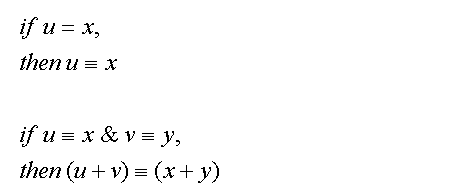
Now, on to a bit on the properties of congruence:


Equations (4)


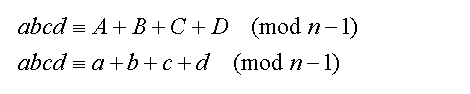
Applying these rules to the number abcd:


Equations (5)


Now, suppose we cluster the digits into groups of two and summing the elements in each group. This is illustrated using abcd= 1534, base-10.

5734
5+7; 3+4
12; 7
1+2;7
3;7
3+7
10
1+0
1

The digital root of 5734 is 1.

Returning to the general case,


Equations (6)


The last step taken is exactly the same those presented in equations (5). Continuing on, the sum of the digits in each bracket is only one digit (for all cases of n greater than 2, the trivial case). This is because both digits are smaller than n, and the sum of two digits, both smaller than n, result in number than when its digits are added, result only in one digit.

Illustrating using base-10, the sum of 2 digits: 9 and 9:
9+9 = 18
1 + 8 = 9

At the limit, n (in this case, n=10) digits may be added and the result remains as one digit:
9+9+…+9=90
9+0=9

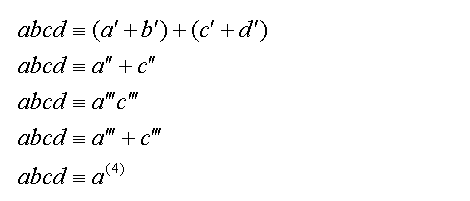
To continue from equations (6), the sums of the bracketed numbers result only in one digit each:


Equations (7)


In equations 7, the digits are further added and finally reduced to the resultant digital root a''''.


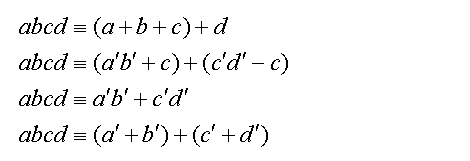
Now, to show that the grouping order of the addition operations do not matter, the grouping of ab and cd will now be reordered to abc and d.


Equations (8)


Which gives the same result as the grouping of ab and cd.


In conclusion, the digital root of a number in base-n is congruent to the number, mod n-1. The digital root is independent on the summation order of digits.


End note: Now, the interesting question is, who would read this? Yuan Harng, most probably. Michelle Chong, maybe. Everyone else just hits the big red x on the top right of the window.

So why did I do this? Because I needed a mental workout.


Labels: , ,

Monday, January 23, 2006

The little one

There was a small but luxurious pre-CNY dinner at an aunt’s house. A pot luck arrangement is usually not associated with luxury, but when the dishes include fancy dishes like sharksfin soup, foil wrapped crabs baked in salt and home made mango loh (with ice shavings and mango puree), one can be sure that this not a simple fried beehoon and diced watermelon affair.


After eating sufficiently, I persuaded a little cousin to let me carry her. She did not allow it.

Later, when my mother was holding her (she is quite attached to my mother), I asked her again. No response, which actually means ‘no, I can’t be bothered with you.’

Mother reassured her a bit, and she agreed to come to me. Thus the influence of a reference is demonstrated.


I brought her around the house’s garden doing the typical things that people do when they bring children around a house: point at the fish in the pond, look at the plants, observe some tadpoles in the pond. We did not ogle at the dog and provoke it, solely because I did not see the creature.

After a tour of the garden and the obligatory ‘waving through the window to mummy’, I brought her back to her mother.


Sometime later I asked her if she wanted to go see the swimming pool at the clubhouse.
A nod.

It turns out the clubhouse was quite far away, but I’ve already committed myself and it is not good ethics to make a u-turn on young kids. So it was a 15 minute walk to the clubhouse carrying this 5 year old girl all the way. Look at the water, listen to the pumps, pluck a few pretty bougainvillea flowers, and it’s another 15 minutes back, uphill.


Back at the house, I went upstairs to one of the cousin’s rooms where a few of them were lazing around not really doing much. I found myself a spot and joined them in lazing around and watching the room’s occupant (attempt to) do her homework in a very distracted manner.

The little cousin nudged the door open tentatively and surveyed the room. Quietly, she came in and paced around for a short while before coming to a stop in front of me. Without a warning, she plopped herself on my lap and made herself comfortable. Not yet completely satisfied with her comfort, she then grabbed my arms and moved them into a more comfortable position. Happy, she remained in that position for a period of time.


***


So, this is what a young child is…. Nice.


Labels: ,

Friday, December 09, 2005

A general, handwaving guide to digital photography - part 3

Continued from section 2 (white balance, light metering, exposure compensation)


Topics in section 3
Flash
Point of view
End note


Flash

Used without care, the flash is a very dangerous tool. It can very easily ruin your white balance, brightness and contrast. While I do not usually use flash, I can make some general remarks based on mathematical arguments.

Not surprisingly, the flash strongly affects objects closest to the camera. In fact, the illumination is inversely proportional to the square of the distance. Double the distance, and it is only one quarter as bright. Triple the distance, and you get 1/9. Quadruple the distance, and you only get 1/16

As you can see, the flash’s effect decays very rapidly with distance. If you have several objects (usually people) that would make up the foreground, and you want them evenly lit by the flash, it is best to make sure that they are all about the same distance away from the camera/flash. Otherwise, objects further away will be darker than those slightly in front.

The use of flash is not limited to dark situations. It can be also used to illuminate comparatively dark areas (usually the subject). A common application of fill flash would probably be to illuminate the subject’s face while under intense sunlight from behind/above. Without fill flash, the face would be cast in a dark shadow. To use fill flash, simply turn the flash on, as opposed to automatic or off.


Point of view

Our view of the world usually takes place from a vantage point about 4 to 6 feet above the ground. For novelty’s sake, you could try to shoot from a low point or a high point. While doing so, you might look a little cuckoo to people around you, crouching low to snap a ground level shot, or holding the camera high in the air and clicking blindly. But who cares of what others think, as long as you might be able to get a special flavour into your shots.


For the high vantage point, I like to use a tripod. Extend the legs fully, but do not unfurl them. Set the timer to 10 seconds (2s is too much of mad rush), hoist the camera above the scene and wait for the shutter to click. This is a bit tricky- you will need to get a few initial shots to figure out the composition while you tweak the camera’s angles. Alternatively, you could stand on a chair, hold the camera above your head and click away. Remember to review after each shot to improve learning via feedback, which is particularly important if you are trying to compose shots blindly.

Apart from shooting from different locations, there are many, many ways to add a dash spice to your photos. You can try shooting through gaps and holes, such that the windowsill or foliage frames the subject. Or experiment with glassware, wire mesh and cast iron grilles, mirrors, stainless steel pots, crystal goblets, lace curtains, grass. Anything and everything goes. After all, the digital format does not cost you money beyond recharging the batteries and replacing them when they finally wear down.


End note

Do your own experimenting; I’ve already contaminated (but hopefully not constrained) you with a little of my style.

Most of us do not have the kind of equipment we would like to have, which is really not surprising. Worry not if you do not have a tripod, or a 50mm prime lens, or a cable release shutter, or an Olympus E-300. This is a clichéd but true concept- the most expensive equipment will not guarantee satisfying shots.

As the diligent reader (anyone who worked through 2000 words is probably diligent) might already have noticed, the theme of this guide is experimentation. Beyond a meagre few technical pointers to give one a bit more freedom of choice, there is little else that I can do to magically aid one’s artistic sense. May fortune be on your side (especially in uncontrolled situations such as metrological conditions).

“And don’t point the camera in the same old ‘square-up’ full frontal way. Tip it, angle it – try something different!” - Weatherburn

“[…] go on a walkabout, determined to look anew at what’s outside your front door. At first this may involve a conscious and almost frustrating effort; but once you’ve run a few reels of film through the camera (or fired continuously with that digital camera) you’ll realise you’ve been walking around, perhaps for years, without “seeing” much at all. […] To take interesting and arresting images of your familiar surroundings will take careful observation, concentration, and imagination – but all the while you’ll be developing the important habit of visual awareness.” - Weatherburn

Thank you for reading. It was a pleasure doing this.


Further reading:

“Photography for Beginners”, by lewcid. strongly recommended
Deviant Art

Deviant Art has loads of marvellous photographs (and drawings, paintings, computer graphics). Browse through them; take a close look at the ones you like. Try to see what kind of tricks the artist used to make that photo. Is it the contrast? Colour coordination? Framing?


References:

Rob Weatherburn, “A Photographic Philosophy”, “Australian Photography” February 2005 p.34-37


Labels: ,

Wednesday, December 07, 2005

What I found in the letter box this afternoon

Dear Graduating Student,

Congratulations on completing your studies and a warm welcome to the University of Melbourne's global alumni community. [...]


***


So I'm done then.


Labels: ,

Monday, December 05, 2005

A general, handwaving guide to digital photography - part 2

Continued from Section 1 (Taking advantage of the digital format, Photo composition, LCD and viewfinder use)


Topics in Section 2
White balance
Light metering
Exposure compensation


I personally like to use the P (Program, I guess) mode on the camera for all occasions. It is automated, but with a large scope of adjustability. The features I find most useful to tweak are white balance, light metering, exposure compensation and flash.


White balance

White balance is the mechanism for which the camera compensates for the colour of ambient lighting. Without it, indoor shots under incandescent lights will appear overly yellow and fluorescent lamps will give a sterile blue tinge. White balance usually comes with settings such as tungsten, fluorescent, daylight, cloudy and of course, automatic.

If you want colours of the sky to be reproduced faithfully, it is recommended that the daylight setting be used. This way, any deviation from white daylight is clearly picked out, like sunset blasts of orange, the silver lining of clouds or the simple blue sky.


Light metering

Light metering is the mechanism by which the exposure is to be adjusted. By measuring the brightness of the image, the shutter speed and aperture is adjusted to allow the correct quantity of light to enter the camera.

Spot metering only considers the light in the middle of the frame, and adjusts the shutter and aperture to expose the middle of the frame perfectly, without regard to the surrounding brightness. Spot metering is usually denoted by a dot within a rectangle.

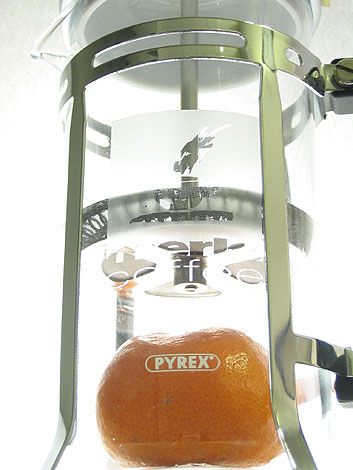
Spot metering is particularly useful if the composition has parts with very different brightness. The following example will illustrate the point.


In this scene, the background is a sheet of paper with a bright light behind it. The orange and the coffee press are placed in front of this bright background. Spot metering was used, and the metering was done on the orange (by holding the shutter button halfway down) and then recomposing the image to move the orange away from the centre.

The result is that the orange is well exposed, and the background washed out. If spot metering was not used, the background will probably be properly exposed, and the subject will be very, very dark. This might be good for snapping silhouettes though.

Have a go at spotting the background, the subject, or even the boundary between the subject and the background. In particular, putting the spot metering box on the boundary between the light and dark elements can give an in-between exposure, and the degree of which can be adjusted by moving the spot area slightly towards or away from the bright region.


Exposure compensation

The process of exposure compensation probably comes somewhere between light metering and shutter release. By setting a negative EV (exposure value), the shot becomes darker. Likewise, a positive EV results in a brighter photo. The exposure compensation icon/button on most digital cameras are either marked as EV or with a +/- sign.


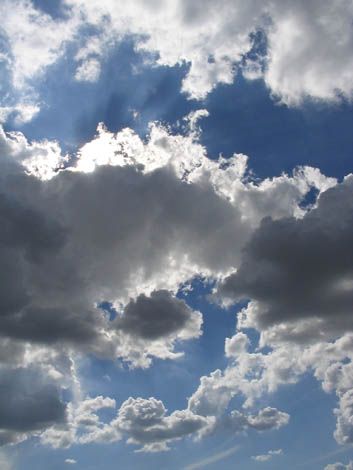
I find exposure compensation useful when intending to capture the clouds in a bright sky. If the blue sky is overexposed, it appears whitish on camera, minimising the contrast with any white clouds. By darkening the scene slightly, the sky retains its blue hue, making the white clouds stand out well. In general, negative EV is good for, but not limited to, situations where brightness makes a colour fade, thus reducing its impact.

Very similarly but for the opposite effect, I sometimes use positive EV in still life macro shots when I want a slightly off white background (usually a few sheets of paper) to look whiter than it actually is.


A fine example of the use of over-exposure of the background. The white background is a sheet of paper.
By Tan Yee Hou; more here


If unsure of the outcome, it is usually safer to just shoot a series of the same shot with range of EV and review the results later. Some cameras have a bracketing function, which will shoot several frames of the same scene, each one with an increment in the EV within a user-defined range. Alternatively, one can manually step the EV up or down through the desired range.


Coming up next
Flash
Point of view
Macro photography


Labels: ,

Sunday, December 04, 2005

A general, handwaving guide to digital photography - part 1

Keywords: general, hand-waving, digital

Side note: The term handwaving is used in mathematics and physics to describe arguments that are not mathematically rigorous. [wikipedia]


Author’s note

Many thanks to Metria, Lucia and Yvy for suggesting and encouraging this project, and to Yee Hou for allowing his photograph to be used here.

This guide will be published over several periods due to its rather frightening cumulative length.

Some additional attention has been given to shooting sky-dominated scenes, in the white balancing and exposure compensation sections.


Topics in Section 1:

Taking advantage of the digital format
Photo composition
LCD and viewfinder use
Coming up next


Taking advantage of the digital format

One main advantage of digital photography over film is the negligible cost of snapping photographs, so long as you have memory in your cards to store them. Added to the fact that not all photos turn out to be good photographs, it makes perfect sense to shoot the same scene several times. We’re not talking about family portrait “one more, just in case” shots, but intentionally different compositions to find the best shot and to learn from experience.

Try it with portrait rather than landscape alignment. What about putting the subject slightly off-centre in the frame? Should the horizon be perfectly level, or do I want it slanted? How much to slant the horizon? Should I focus on the foreground or the background? Can I recompose the shot to remove that coconut tree from the girl’s armpit? Put some thought into the composition before clicking the shutter release.

Shoot shoot shoot. Experiment.

After every shot, review it just so you know what is happening and learn from it immediately. Even if it’s uninspiring, do not delete it until you see them all on a computer- the camera’s LCD is not sufficiently detailed to judge which photo is better.

Look, you got that digital camera because it allows you to shoot at almost no cost, and review photos on the spot. Do not waste that investment.


Photo composition

Many photography books, tutorials and guides recommend the rule of the thirds. Divide the frame into 3 vertical portions and 3 horizontal portions. Major features should lie along these lines- the horizon one third or two thirds of the way up the frame, and the coconut tree one third or two thirds to the left of the frame.

However, I personally find that this is not a very reliable rule. It might be that this system of thirds was derived from the Golden Ratio. I fiddled with my calculator and found that the proportion is 0.61803 compared to two thirds, which is 0.6666.

Regardless of the actual derivation of the thirds, try putting the horizon (or any other major feature/boundary) at the one third or two third marks, then shifting it up and down (or left and right) a little to suit your preference. Don’t forget to shoot them all, just to be sure of the results.

Also, break the rule of the thirds as and when you like. Experiment with the horizon in the dead centre, or sliding all the way from the upper left corner through to the bottom right.


Photo composition sometimes feel very much like creative damage control. The background scenery is beautiful, but in the foreground there may be annoying road signs, diseased dogs wandering about, dumb tourists milling about mindlessly, power and telecommunications lines on poles, an unwelcomed tree… the list of potential spoilers is endless.

After choosing your intended foreground and background objects, check if there are objects that are not part of the desired photo. You may have to zoom in and out to find the best zoom to fit the frame between two offending lamp posts, or juggle the frame left and right to avoid both the rubbish bin and the edge of the billboard.

Do not dedicate all your attention to centring the subject or putting the horizon on the one-third mark. Spend some time observing the rest of the frame, which is where foreign objects will turn up and ruin your photo.


LCD and viewfinder use

Since the LCD is where you would be reviewing most of shots in preparation for the next, it is best if you know what sort of behaviour your LCD exhibits. I know of a Canon A70’s LCD that consistently gave me over-bright images, deluding me into thinking I’ve got the right exposure when in fact the photograph was too dark for my liking.

If your viewfinder is not an electronic one (with a tiny LCD in it), avoid using it for composing the photo. The LCD shows the exact image that the sensors pick up, but the viewfinder might not be perfectly matched to the main lens’ zoom. Thus, the viewfinder’s frame might be too small or too large, seriously messing up your composition. This recommendation does not apply to SLR users, whose viewfinder image is an exact duplicate of what the film/sensor will see.


Coming up next

White balance
Light metering
Exposure compensation


Labels: ,

Thursday, October 20, 2005

I made it into the Master List of Stupid Things (again) !

Somewhere out there beyond our sensory apparatuses exists a Master List of Stupid Things. It would be pretentious to say “there lies a Master List” since we do not even know if this list is of a longish shape that can be oriented horizontally. Or for that matter, define horizontal.

Somewhere out there, beyond the scope of our ears, noses, orbiting telescopes, very large radio telescope arrays, spiritual mediums, astrologers, crystal-orb gazers, intuition, and gut feeling, exists this Master List.

Rumour mongers and chain letters, but surprisingly not including chain email, claim that Section 1 of this Master List deals with “accidental death by negligence”. An entire subsection 1c is dedicated to “ ‘Don’t worry, it’s not loaded’ and similar misjudgements”. The origins of these claims are entirely unknown, since this Master List is beyond human perception and thus nothing about it can ever be known. Theorists and speculators are of the opinion that these claims are the product of the rumour mongers’ deranged imagination. Conspiracy theorists, on the other hand, categorically state that the opinions of these theorists and speculators are part of a government cover up story concerning the mind reading probes that can also detect and read the Master List. Which government, though, is subject to argument as some say the United States, the ex-Soviet Union, or even Omicron Persei VIII*.

Nonetheless, the Master List of Stupid Things exists. That much is certain.


***

Today, I have caused yet another instance of my name to be added to this Master List. This is my story.

I was walking home in the rain. As usual, without an umbrella.

As I walked past an ice-cream parlour, I realised two things:
I haven’t had a gelato in ages (about 2 months, to be approximately precise)
I was hungry


And so I got my three scoops of wonderful gelato (rum & raisin, almond, choc & orange) on a cone.

Like racing tyres, ice-cream behaves differently in wet weather. Rain drops hitting the ice cream form a layer of water on the surface of the ice cream, dissolving a little of the ice cream, and causing little rivulets of liquid that while not exactly a waterfall, are extremely difficult to control by tongue.

I ended up having ice-cream solution plastered over my fingers in a sticky mess.

Ice-cream should be enjoyable. Definitely not frustrating, annoying and exasperating.


***

Thus in summary,
Do not eat ice cream in the rain, even if it looks like it’s “only a drizzle”.
Yet another entry in the Master List of Stupid Things is in my honour.


* Persei pronounced per-see-I:
per as in “RM45++ per person”;
see as in “Can't you see that I am busy?’
I as in “I am Lrrr, ruler of Omicron Persei VIII.”


Labels: , ,

Thursday, June 23, 2005

Silly Pranks 1

It was the third day of Chinese New Year, and it was going to be a quiet night at our grandparent’s place.

My cousins, brother and I were in the midst of a particularly slow game of mah-jong when we decided to go for a “drive”.

“Take the bag of bombs,” someone reminded someone else. The bombs in question were little balls of about 25 mm across, with explosive powder in a plastic outer shell and a fuse protruding ominously. Calling them firecrackers would be slander- they don’t crack; they go BANG! Retailing between RM30 to RM50 per bag of 100 balls, these bombs are available from most illegal fireworks dealers near you.

We piled into a car, and cruised around various residential areas that were not too near from where we staying. It was thought that putting one of those bombs into a dustbin and closing the lid would produce interesting effects.

“There’s one!” indeed there was a promising dustbin- a smallish, light weight plastic one. And nobody appeared to be awake in nearby houses. I drove up to it.

“Do you want to light it?”
“Ok. You hold the lid open, and when I drop it in you shut it.”
“Leave the car doors open. I’ll come in from this side, and you go round to that door.”
“Drive the car a little bit ahead.”
“Ok. You two get down; we’ll move ahead and then open the doors for you.”
“Remember to open the doors.”
“Don’t do anything until I’m ready. Wait till I’m off the brakes and holding at first gear.”

And so the planning went, meticulously.


Finally, we were ready. I had let off the brake, engaged first gear and holding the car on the clutch. From the rear view mirror, they were visible, one with the dustbin lid, the other with a lighter. Just as they were to do it, one of them was overcome by a giggling fit, and infected it upon the other. Watching from within the car, we had our silly giggles. A few more false starts, they finally got their laughter suppression act together and got the bomb inserted and sealed.

They ran towards the car, smiling like monkeys.

When the explosion came, a sudden flash lighted the bin from the inside, the bin hopped some millimetres off the ground, and the lid flew a few feet into the night sky. Dense white smoke began to issue from the opening of the dustbin like water vapour from a cooling tower.

We laughed like idiots.


to be continued...


[Help- "one of them was overcome by a giggling fit". Is it overcome or overcame? Why?]


A cooling tower with a plume of condensed water droplets.

Labels: ,

Thursday, April 28, 2005

Attachments

Early this morning, I was chatting with a friend, and we arrived at this point:

(I’m in green)
:
:
:
teen angst...
fortunately, never had those moments
hmm... what about [name omitted]....
although some would argue one is misisng out on part of life
well, that was closer to infatuation. not a deep rooted 'thing'
i see... so you doing any girl hunting these days?
no, not that preoccupied
its not very wise too. if an attachment may be formed, it will eb messy, since i'm leaving [Melbourne] end of this year
most probably
very sensible indeed... attachments are indeed problematic
anyway... i got to get dinner done now
i'll ttu some other time
yea, i'm off to bed
ttyl


That pretty much sums up my approach to certain aspects of life. Please note the escape word “certain”. Hence, please do not come to me and ask, “Why are you mourning the loss of a manual gearbox? I thought you had no attachments?” Which at that point I might either slap you or challenge you to a double-clutch heel-and-toe down-shift exercise (what a lot of hyphens!).

Some people have the opinion this is simply a fear of commitment. Others might infer it as fear of taking risks. A few might deduce that I’m a hermit (they might be right to a certain extent).

Whatever.

It’s also possible to arrive at the conclusion that I’m quite partial to some of the teachings of Siddhartha Gautama.

On another note, notice that I’ve taken the trouble to use different words for similar applications in the above sentences: opine, infer, deduce, and conclude.

Labels: ,

Sunday, February 27, 2005

Nail Grinding and Polishing

About a week ago, I chanced upon a nail filing and buffing device at home. It was a simple piece of kit, consisting of a stiff plastic base, with abrasive surfaces bonded to the plastic base. To improve grinding and polishing performance, the abrasive surfaces were mounted on a thin layer of foam, such that the abrasive surface is allowed to deform to constantly fit the nail’s curvature. The first and most abrasive of the grinding surfaces was emery. Subsequent stages were unceremoniously labelled 1, 2 and 3.

“Interesting…” I thought to myself. I decided to try it on my left thumb. After some strokes of rubbing using emery, my thumbnail had been removed of all grains. The nail surface itself took on a powdery texture with a diffuse pinkish white colour. After stage 1, the powdery texture had disappeared, and resembled the colour and feel of a natural nail. At the end of stage 2, a marked degree of reflectivity had appeared. One wonders what stage 3 polishing will bring…

Several strokes of polishing using stage 3 resulted in an unnatural lustre. The nail’s surface was smoother than brand new PVC bottles’ finish. One could catch well defined reflections from bright windows on the nail. A natural nail would show some light as an indefinite smear of reflection while a polished nail will show a great amount of detail, including large grilles and the straight edges of the window frame.

“This is fun. I’ll do it to the index finger as well.”

About 5 to 7 minutes later, I had a second polished nail.

This led me to a new set of problems. Previously, the grains in the nail surface were large scale, and any additional scratches and aberrations on the nail went unnoticed. However, as the surface got more and more polished, smaller and smaller scratches and irregularities will become visible. As a close analogy, compare similarly sized cracks in a brick wall and in a smooth plaster wall.

To preserve my hard earned polish, I either had to take care when working with my fingers to prevent scratches (which was dumb), or to give it a stage 2 and 3 polish every day (which was just as dumb). Thus, the obvious solution was not to have polished nails.

However, this solution led me to another array of problems. I was unwilling to let go of the smooth finish that polishing will impart upon my nails. Clearly, I’m going down a path of many unnecessary problems. By attaching myself to impermanent characteristics, I’m bound to be disappointed when the characteristic in question decays. Hence I strive to maintain the status quo. Unfortunately, the status quo takes a lot of effort to maintain, as mentioned previously.

Sadly, I don’t learn easily. I was on holiday, and time was on my side. One night, I did the remaining 3 nails on my left hand. Now, half of my fingernails are shinier than new PVC bottles. I imagine that it would be extremely time consuming to do all 10 fingers in one sitting. Imagine, 5 to 7 minutes each finger comes up to a staggering 50 to 70 minutes. I randomly queried a few people (all of them girls), and not surprisingly, they do not buff their nails.

Despite the fact that giving my 5 nails a daily polish is exceeding time consuming and pointless, I still went on with it. It was not because it was pretty to have shiny nails. The objective was not good looking nails, but shiny nails. Even if they are so shiny that it becomes ugly, I will probably continue at polishing, because the goal is smoothness, not aesthetics. It was developing into a disorder, an obsession. It is possible that eating disorders stem from people losing sight of their objective (a trim figure) and switching to a different objective (light weight).

The owner of the nail buffing device offered to let me take it with me to Melbourne. “Definitely not,” I replied. I’ll be better off without it.


As a side note, I'll not be experimenting with lipstick and eyeshadow. Just to reassure you that I'm not mad.

Labels: , ,