Sunday, June 28, 2009

When the visual cortex stops working

Today, I watched my brain turn itself inside-out. A thoroughly frightful experience, but very “interesting” (but only in the way a scientist would use the expression).


I had just disembarked from the overnight sleeper train from Tianjin, and was making my way out of the Shanghai train station towards the metro station. All of a sudden, I felt faint. After I climbed a flight of stairs up to ground level, it felt much worse. I was wobbly, and had to stop walking to hold on to a wall to prevent myself from falling over. My vision blacked out completely- I could see nothing. This lasted for about 10 seconds.

My sense of balance was failing rapidly, and even the wall was not helping me keep upright. I had to squat down and brace my head in by hands. All this while, I was worried my condition would deteriorate further causing me to keel over and pass out on the wet pavement in the rain (and lose my computer, passport and phones). This lasted for approximately 10 seconds until my sense of balance and vision returned, just barely.

I became aware of a motorcycle-taxi behind me asking if I needed a ride. I told him my address, he quoted me 15 yuan. It was a slaughter (a normal taxi would have cost 11 yuan), but I was in no shape to haggle.

I was able to get on the bike and keep myself in balance without problem, but my vision was still bedlam. In hind sight, this is not very surprising as the visual cortex is of substantial size, and visual processing is a very resource intensive task.

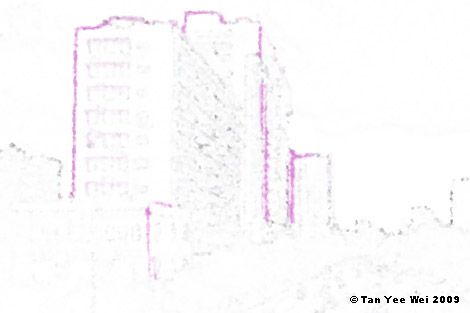
Below is a Photoshop recreation of my rather useless sense of vision at that time.
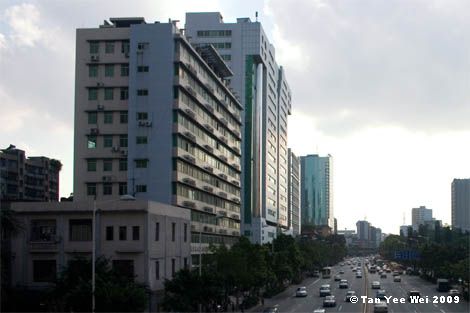


Normal view

Click here for large size image


WTF view

Click here for large size image


Allow me to attempt to describe what little I could see.

It was an overcast day with light drizzle, so the sky was entirely white. My field of vision had returned to normal, however, everything was in very very low resolution. In the middle of my field of vision, I could ‘see’ some detail, but everything else was a blur of white and splotches of dull colours.

When I look at buildings, I see it as if it was a pencil sketch on white paper. I could perceive some of the edges of buildings- these edges were rendered in a plain purplish colour. The rest was mostly white in colour. It appears that the perceived edges were moving with respect to my field of vision. This is consistent with findings that moving objects are easier to detect compared to stationary ones 1. Conceivably, the perception of moving objects is given a higher priority in the visual processing part of the brain.

Over the course of 5 minutes, I regained my sense of vision. I could walk and keep balance as if nothing had happened.


Footnotes:
1 – This is important for the survival of many species. A moving object could well be a predator, and being able to detect a predator early would increase the creature’s chances of not being eaten.

Labels: , ,

Friday, August 01, 2008

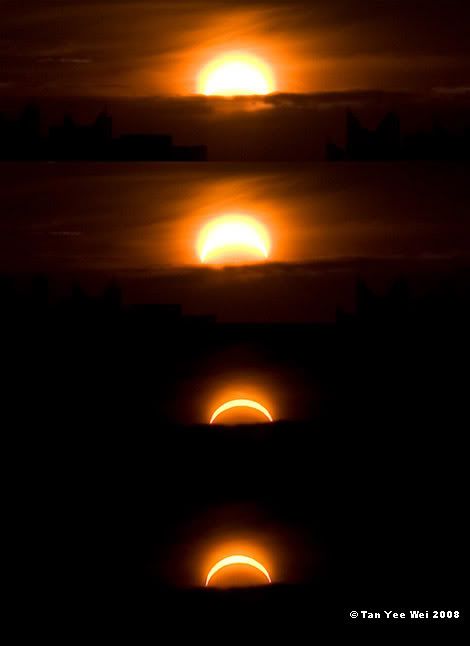
01/08/08 partial solar eclipse over Tianjin

Today, a total solar eclipse was visible for observers along a long, narrow region in the northern latitudes. A partial eclipse, however, was visible from a much larger area. [view affected areas]
Populations in the Greenland, the entire of Europe, most of the Middle East, the entire Indian subcontinent, most of Russia and China except for the eastern-most coasts could observe at least a partial blotting of the sun.

At Tianjin, the eclipse spectacle appeared to be a no-show due to cloud cover. However, just a few minutes prior to sunset the sun revealed itself from behind the clouds.


Click here for large size image


The eclipse was not obvious due to the brightness of the sun; it would not be wise to stare at the sun with the naked eye. However, brief glances with a skimming motion could reveal that the light source was not symmetrical.

By using the lowest sensitivity setting on a camera and short exposure times, it was possible to verify that something had taken a bite out of the sun.


Solar Eclipse

Click here for large size image
ISO 100, f/16 and various exposure times


As the earth continued to rotate, the sun hid behind more clouds, and the show was over.

Labels: ,

Tuesday, April 10, 2007

Microscopy: chilli slice and fly

Photos captured using a Panasonic FZ-30 with a reverse mounted Super-Takumar 50mm f/1.4 and a Vivitar 28mm f2.8. Stopped down, the Super-Takumar is absurdly sharp, as vividly demonstrated in the first fly images.


Click here for large size image


Click here for large size image


Click here for large size image
Green channel of a colour photograph


A full-sized crop of the preceding image


The next images might be disturbing to some people. They are closed up images of a fly's various anatomical details, including but not limited to the compound eye, transparent wing, hairy thorax and barbed legs.

Please do not complain that you were eating/drinking tea/having sex and this post made you throw up.


Click here for large size image


A close up of the wing's joint


Click here for large size image


Click here for large size image
The wing's leading edge is serrated


The Eye


Labels: , , ,

Monday, April 09, 2007

Sentience in pure science

Back in the dark days when I was in upper secondary school, our physics teacher was a large and lackadaisical man who by his flexible and whatever attitude allowed us to be slightly rowdier than what other teachers would tolerate.

An incident which remains stuck in my head occurred shortly after a term exam of minor consequence. A few of us were idle standing around the physics teacher as he marked the exam scripts. We openly laughed at some of the classmates’ impotent attempts at salvaging marks, and when the teacher gave each question a score, we would urge him to lower it. Occasionally he did, much to our entertainment.


A particularly hideous phenomenon I noticed on that occasion (but exists even in academia) was the projection of sentience onto mechanical systems. The question of “why does a rolling ball’s speed slow as it rolls up an inclined surface?” was answered with “because the ball is trying to go up the slope but gravity is trying to pull it down.”

By granting the ball and gravity sentience and intention defeats the entire purpose of pure science; it borders the behaviour primitive religions that imbue rocks and celestial objects with spirits and souls. In contrast, pure science does not allow balls and black holes to have intents of their own – otherwise two balls of identical construction would ‘want’ to climb different trees or conquer their own galaxies, behaviours which have not been observed and documented so far.

The construction of pure science partially revolves around the concept of repeatability, a concept which is destroyed by the introduction of sentience. However, it is not for the preservation of the current understanding of science that sentience has been disallowed to be introduced in the understanding of balls; it is because balls have been behaving so consistently that many think that the balls in fact do not have sentience whatsoever.


A nastier example of the projection of sentience is embodied in the common and easy to remember idiom, “nature abhors a vacuum.” Besides the fact that nature not only is given sentience but also emotions, this idiom also wrongfully generalises the behaviour of fluids. A question on HowStuffWorks asks “if nature abhors a vacuum, then why doesn't the vacuum of space suck away all of the Earth's atmosphere?” (The question assumes that nature dislikes a vacuum, but the answer is worse- through a series of logically unsound arguments, it suggests that “nature loves a vacuum.”)

Labels: ,

Friday, March 09, 2007

The fine-structure of an avian feather


Click here for large size image
Supar Takumar 50mm f/1.4 with makeshift extension tube, on ASA 400 Fujicolour film


Click here for large size image
Supar Takumar 50mm f/1.4 reverse mounted on Panasonic FZ-30


Click here for large size image


Click here for large size image
Vivitar 28mm f/2.8 reverse mounted on Panasonic FZ-30
Note the preposterous diffraction effects in regions that are out of focus


Click here for large size image
A closer view of the previous photograph. Observe the porous core of the main shaft.


A full sized crop of the preceding images, this image gives a resolution of 776 nanometres per pixel.
Viewed on a monitor, it gives an appriximate magnification of 400x.

Labels: , ,

Wednesday, October 25, 2006

Lepidoptera portraiture

Author’s notes
Warning: due to the large quantity of highly detailed images, please exercise patience.

Except for the two photos indicated, all images have not been cropped. The remarkable magnification was achieved with optics alone. Photoshop was used to only watermark and resize.


A moth visited me yesterday night. It was a decently sized creature, with a wingspan of about 4 cm. I cupped it in an upturned food container and slid the lid on. The creature flitted maniacally in the clear box, hitting the sides and changing directions haphazardly.


Fridgey the Moth


Trapped within a box which once contained green curry, the moth could see it was being carried along through the house. Its captor stopped in front of the fridge and pulled the freezer door open. The door’s magnetic and rubber seals unstuck with a fridgey sound. Cold air washed out of the chilled space, its motion marked by a turbulent cloud of cascading mist.

The box with the moth was put into the cold space and the door shut. It became dark.

In the mercilessly cold freezer, heat rapidly ebbed away through the container walls. The moth’s core body temperature dropped steadily. Being a cold blooded animal, its metabolic rate was directly dependent on temperature. As the box cooled, the moth stopped fluttering in the darkness. It perched itself on the floor of the container and folded its wings.

The temperature continued its inverse-exponential decline. The moth went to sleep.


***


From El Salvador to Kuala Lumpur, it is said that the powder shed from a moth’s wings can cause blindness.

It’s actually not powder, but scales from the moth’s wings. Let’s take a closer look.


On Wings of Gold

Click here for large size image


Click here for large size image


Click here for large size image


Click here for large size image


Click here for large size image

This is a 100% crop of the previous image. The magnification of this image on screen is approximately 400x.
Note the fascinating shape of the individual scales.


And the face of the mo(n)th:


Click here for large size image
Frontal view


Click here for large size image
Side elevation


Click here for large size image
Note the curled up feeding tube (proboscis). That device is used for sucking nectar from plants.


Click here for large size image
Note the long thin hairs growing from the compound eye’s surface.


Click here for large size image
This is a 100% crop of the previous image. The magnification of this image on screen is approximately 400x.
Each unit in the compound eye has its own cornea, lens and photoreceptor.


Fridgey the Moth did not wake up from his sleep. We would like to give it a big 'thank you' for contributing to today's enlightening post. We will never forget you.


Labels: , ,

Saturday, September 09, 2006

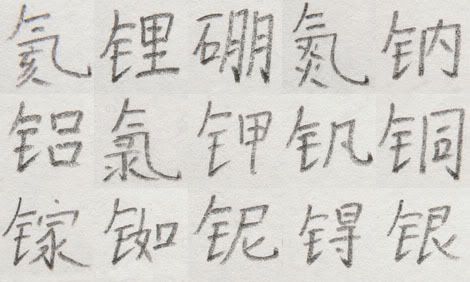
Here’s a little puzzle:

There exists a function ƒ(n) which takes a natural number n as an argument and returns a character.

It can be said with certainty that natural numbers smaller than 20 are in ƒ’s domain.

ƒ(n) for the first 15 values of n is exhibited in the image below, in the following order:

ƒ(1) ƒ(2) ƒ(3) ƒ(4) ƒ(5)
ƒ(6) ƒ(7) ƒ(8) ƒ(9) ƒ(10)
ƒ(11) ƒ(12) ƒ(13) ƒ(14) ƒ(15)


Click here for large size image


Define ƒ.
Estimate the domain of ƒ.


Hint:

Here is a dictionary.


Labels: ,

Friday, August 11, 2006

An alternative interpretation of the measurement problem found in quantum mechanics

Assumed knowledge:
Some familiarity with Young’s double-slit experiment and quantum mechanical implications of the results.


One very fundamental problem in quantum mechanics is the ‘measurement problem’, in which the act of measurement itself is destroys interesting quantum effects.

The simplest example is using the two-slit experiment. The wave-like nature of light means that constructive and destructive interference result in the familiar fringes of light and dark bands.

If the light source’s intensity is reduced such that only photon is in the system at anyone time, as photon hits accumulate on the detector, the same fringes emerge. The obvious questions at this point are, "how is one photon interfering with itself? Did it go through both slits at the same time?"

Light detectors are then installed behind each of the slits, the objective being to identify which slit the photon actually went through. Unfortunately, and mysteriously, the interference pattern disappears.


Oftentimes, the explanation for this phenomenon is presented by invoking the Heisenberg Uncertainty Principle. On the other hand, Von Neumann and Weigner believed that it was the conscious observation that resulted in the collapse of a wavefunction. Still other interpretations claim that the experimental apparatus itself is part of the experiment, and the results show what the apparatus was designed to show: the wave-like or particle-like nature of light. The many-worlds interpretation raised by Everett is so radical that it is difficult for me to write his proposition succinctly.

However, I personally feel that these do not address the problem satisfactorily, and have developed a handwaving interpretation of my own, based on interactions and wavefunction collapse and reformation.


It would be appropriate to first describe the wavefunction in a general manner. In a handwaving way of explaining it, the wavefunction of a particle is a function that describes the probability of finding the particle in a particular location in space(time).

A wavefunction is said to collapse when the particle's position is 'revealed', so that it's position is no longer a probability distribution, but a definite point in space(time). At that moment, the probability of finding that particle is zero everywhere except where the particle is located.


We will now construct the experimental apparatus by considering the simplest case and incrementally adding elements of complexity to it to finally arrive at the double-slit set up with photodetectors.

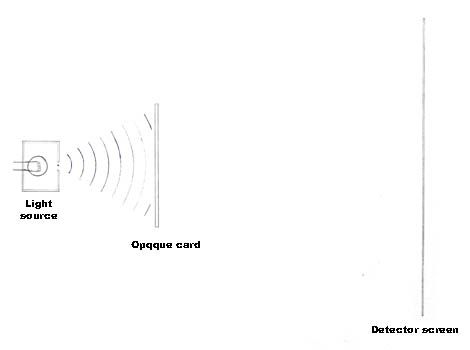
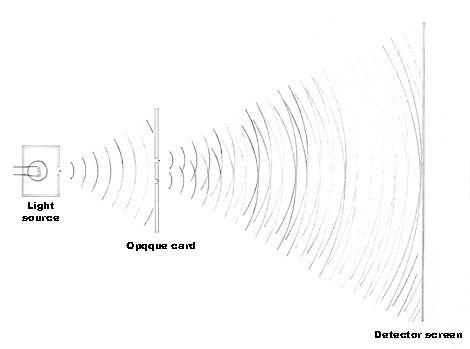
A light source, an opaque card (of sufficient thickness to prevent tunnelling effects) and a detector screen are arranged as in the double-slit experiment. However, the opaque card has no slits. All the light that is directed towards the card falls on the card’s surface.


Figure 1: No slits in the card; all light falls on the card’s surface.


From a wavefunction point of view, the wavefunction gives a probability of a photon striking a particular area of the card. When the photon strikes the (interacts with) card, it does so at one point, and the wavefunction has collapsed into a point at that location.

Also note that the presence of the opaque card has modified the wavefunction such that the probability of the photon striking the detector screen is zero.


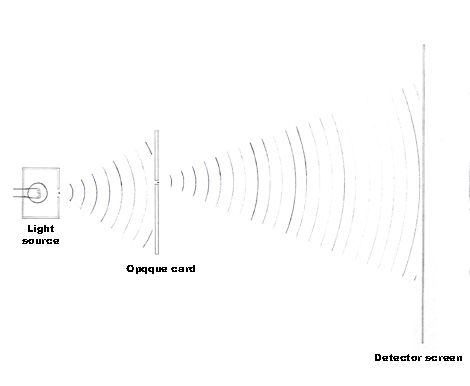
A slit is then cut in the card, and we see that while most light falls on the opaque card, some of it hits the detector screen.


Figure 2: One slit in the card; most light falls on the card's surface, but some reach the detector screen.

As one can see, the probability of finding the photon on the detector screen is no longer zero.


A second slit is cut into the card, and the detector screen shows the typical interference patterns that have become associated with the double-slit experiment.


Figure 3: Two slits in the card; most light falls on the opaque card's surface, but the light that falls on the detector screen has alternating light and dark bands that are characteristic to interference.


Photodetectors are then installed at the slits to observe which slit the photon 'actually' went through. The function of these detectors is to alert the experimenter when a photon passes through one of the slits. How the photodetector works is not of interest to us, but we can be sure that the photodetector has to interact with the photon if it is to send a signal that "yes, a photon has passed through."

And here comes the crux of my argument- interactions requires the whole photon’s participation (not merely the probability waves). Thus, only a wavefunction that had collapsed in the detector can produce an entire photon which is capable of interacting with the detector.


Name the photodetectors A and B. If A had sent a signal indicating the passage of a photon, this means that the photon had interacted with A (assuming that A is not faulty). The interaction means that the photon's wavefunction had collapsed into a point in the detector, manifested as the photon (a particle). The wavefucntion's collapse means that the probability of finding this photon on the opaque card or in photodetector B is zero- the photon is definitely in A, and thus definitely not in B nor on the opaque card's surface.

However our photodetectors are designed to allow the photon to proceed on its way to the screen, which means a new wavefunction is produced upon the old one’s collapse. The new wavefunction describes the propogation of a photon from detector A towards the screen. Since the wavefunction of a photon heading towards the screen comes from one source (detector A), there is no interference.


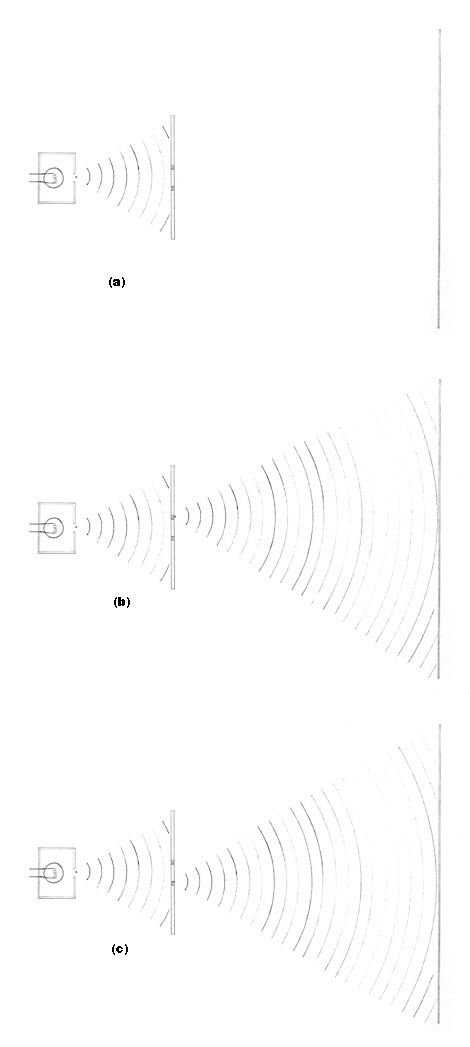
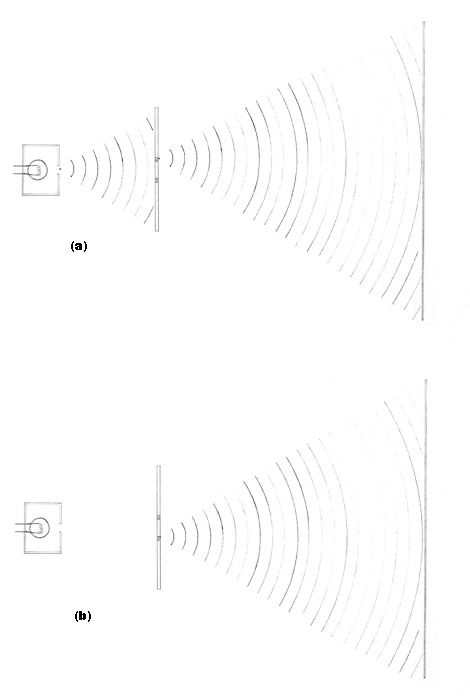
Figure 4:
(a) The photon strikes (interacts with) the opaque card, and the wave function collapses. This photon will never make it to the detector screen.
(b) The photon interacts with photodetector A, and the wavefunction collapses into the detector. The photon then continues on towards the screen, propagating as a new wavefunction originating from detector A.
(c) The photon interacts with photodetector B, and the wavefunction collapses into the detector. The photon then continues on towards the screen, propagating as a new wavefunction originating from detector B.


The interference pattern can also be made to disappear by using only one photodetector behind a slit. In this case, the initial wavefunction is such that there is a probability for the photon to strike the opaque card, strike the detector in the slit, or strike the screen. Any one of these interactions will cause the photon to exist as a particle, and the wavefuction to collapse.


Figure 5:
(a) The initial wavefunction shows that there is a probability for the photon to strike te opaque card's surface (which is not exciting), strike the detector screen (which is interesting) or interact with the photodetector hidden behind the lower slit (which is even more exciting).
(b) If the photon did interact with the photodetector in the lower slit, the initial wavefunction collapses, and a new wavefunction is formed. Note that there is no interference.


Thus the double-slit experiment and measurement problem has been explained by using the argument that an interaction requires the whole particle's presence, which means that the original wavefunction has to collapse, and a new wavefunction to propagate from that point.

It must be noted that the photodetectors behave similarly to the opaque card: it does not allow the wavefunction to have a non-zero value behind it. Hence, a photodetector absorbs photons, just like the opaque card. The difference lies in the fact that the photodetector then spits out that photon after having detected its presence. This new emission event corresponds to a new wavefunction.


Author's note:
Some feedback on the workability of this proposition please? Thank you.
Mr Lee, I'm counting on some sort of response from you.


Labels: ,

Thursday, May 25, 2006

An interesting difference between the human eye and a still camera

Warning: Slipshod handwaving arguments ahead. Rigorous people proceed with care.


There are many comparisons that draw attention to the similarities between the human eye and a still camera. Today, I will point out one interesting but rarely, if ever, mentioned difference.


In the human eye, the signal strength can be assumed to be approximately proportional to the quantity of light falling on the retinal cells.

Simplistically,


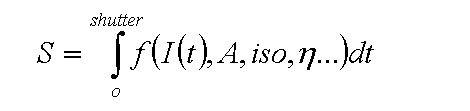
Where the signal strength coming out of the eye is a function of light intensity falling on the retina, aperture of the pupil, retina sensitivity, efficiency and other eye-related parameters.


In a still camera, there is one more parameter that dramatically changes the form of the equation- the exposure time.


Here, the fact that light intensity that falls on the sensor can vary with time is highlighted, hence it is not a constant but denoted by a time-dependent function I(t). Aperture, sensor sensitivity (ISO), light transmission efficiency and other camera-related parameters are assumed to be fixed for each exposure.

And, the signal strength is the time integral of the function. Which sort of makes sense, since doubling the exposure time in the presence of a constant light source results in photographs twice as bright.

It is exactly this time integral that allows double exposures to be made, where the film is exposed to two different scenes to create an overlapping image.

If the exposures were made 24 hours apart, then the integral can be taken to be starting from 0 and ending 24 hours later, with I(t) being zero for a large proportion of the time (since the film was not exposed to light between exposures).


Labels: , ,

Saturday, April 29, 2006

Wonders of the human eye

Current read:
Pirenne MH, ‘Vision and the Eye’, C. Tinling and Co., 1967, London.


The eye: an optical sensor so utterly magnificent that it is consistently used in arguments in favour of religious doctrine.

Disregarding this irrelevant hoo-ha, let’s talk a little about the human eye itself.


The eye can work with a huge variation of illumination, from direct sunlight to illumination by mere starlight (I have experienced this on a clear moonless night far removed from civilisation- the environment remains slightly visible).

The most obvious mechanism is the iris, which regulates the size of the pupil (the orifice that allows passage of light towards the retina). In dimly lit conditions, the pupil dilates to allow more light to strike the retina (the photo-detector), thus improving sight.

However, there is an obvious limit to how much the pupils can dilate. To further extend the operating range of the eye, the retina is equipped with 2 different photo-detectors: rod cells and cone cells. Cones work well with bright light and also respond to colouration of light; rod cells respond to dim light and do not give colour information.

Thus in bright conditions, the rods may be saturated (that is, their output is at maximum) but the cones will be able to provide information regarding the quantity of light falling on each cell. Conversely, the cones will return a zero signal in dim conditions while the rods give good data.

This effect can be observed when one looks at the stars. Bear in mind that cone cells are more densely clustered in the middle of the retina and rod cells are distributed around the periphery. It is often noted that the star that one is explicitly trying to stare at persistently fades from sight- cone cells are not very good at sensing dim light sources. The way to observe a star is to stare away from it and look at it using your periphery vision where the rod cells dominate (and give good low-light seeing).

Compared to a photographic camera, the situation is analogous to having a mixed sensor of say, ISO 50 and ISO 400.

Apart from the variable aperture found in the pupil and the mixed sensor in the retina, the eye has one more trick up its sleeve that further extends its operating range. The light detecting cells have the ability of changing their sensitivity, although this effect is not instant but requires durations on to the order of minutes.

Returning to the photographic camera analogy, one might find that the sensors automatically change from ISO 50 and 400 to ISO 200 and 1600 respectively.

In experiments that attempt to deduce the minimum light required for detection, the test subject is usually dark-adapted (enclosed in a completely dark room) for up to 45 minutes to allow this sensitivity to increase to its maximum. Initially, the sensitivity increases rapidly and this increase slows down until it reaches its maximum.

Experiments conducted in the middle 20th century showed that the eye can detect incredibly dim light flashes. A suitable dark-adapted test subject can detect light flashes of blue-green in colour (wavelength of 507μm) of merely 50 to 150 quanta, corresponding to a range of 0.02 to 0.06 femto-Joules (10^-15 J).


Efficiency of the light sensing element in rod cells

Rod cells contain a pinkish pigment rhodopsin, also referred to as ‘visual purple’. When exposed to light, this pigment changes from pink to clear- absorption of energy provided by light bleaches the pigment. The reaction stimulates nervous endings in the rod cells, thus giving the resulting information on amount of light falling on each rod cell.

The previous experiment showed that about 50 to 150 photons need to enter the eye for the flash to be detected. However, not all this light is absorbed by the rhodposin. Absorption occurs at every stage the light passes through- the cornea (the outermost layer of the eye), the aqueous humour (a fluid between the lens and the cornea), the lens, the vitreous humour (the gelatinous mass in the eyeball), the finally rhodopsin.

However, the rhodopsin does not absorb all light falling on it, and some is transmitted to other parts of the slightly reflective retina. Light reflected by the retina then reverses in direction and exits the eye in the same manner it entered, again with a proportion being absorbed at each stage it passes through.

As already stated, it is known that 50 to 150 photons need to enter the eye for detection to occur, but how much must be absorbed by the rhodopsin itself?

To find out, very dim light of known intensity is shone into the dark-adapted eye of a test subject. The quantity of light that is reflected back out of the pupil is measured. By comparing the two values, the quantity of light absorbed by the entire eye is easy to deduce.

Next, a bright burst of light is shone into the eye. This serves to bleach the rhodopsin so that it no longer absorbs more light.

Immediately after, before the rhodopsin returns to its pink hue, another dim light of known intensity is shone into the eye, and the reflected intensity measured. Again, the quantity absorbed by the entire eye is easily deduced.

By comparing the absorption of light with and without rhodopsin, the quantity of light absorbed by rhodopsin can be inferred.

It was found that a mere 5 to 15 photons are required for optical stimulation, which is remarkably close to the theoretical limit of 1 photon.


Labels:

Tuesday, February 21, 2006

A brief introduction to tidal forces

For me, the tides have been slightly troubling for as long as I can remember.

The most disturbing question was, why does high tide occurs on both sides of the earth in an elliptical shape, and not only the moon facing side?

The question was partially answered when I came across one of the last few chapters in 'Gravity: an introduction to Einstein’s general relativity'.


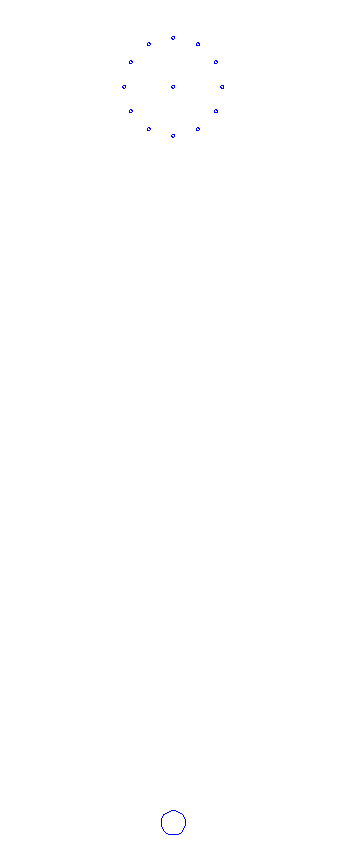
Consider a large array of small objects (mangoes, for example) freely falling towards a massive object (such as a star). Note that the separation of the individual mangoes is sufficiently large that the gravitational force and direction is not the same for all the mangoes.


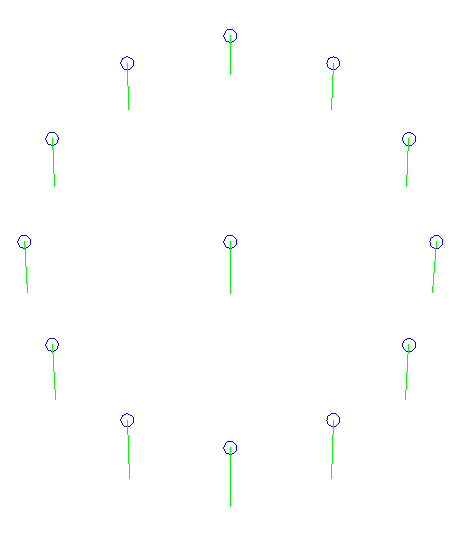
At a particular time, the mangoes are arranged in a circular fashion with one of them in the middle as shown. The gravitational force vectors acting on the individual mangoes are also illustrated as arrows indicating the direction and magnitude.


As expected for gravitation, the relationship is proportional to the inverse of the square of distance. Thus, a greater force is exerted on mangoes nearer to the star than mangoes further away.

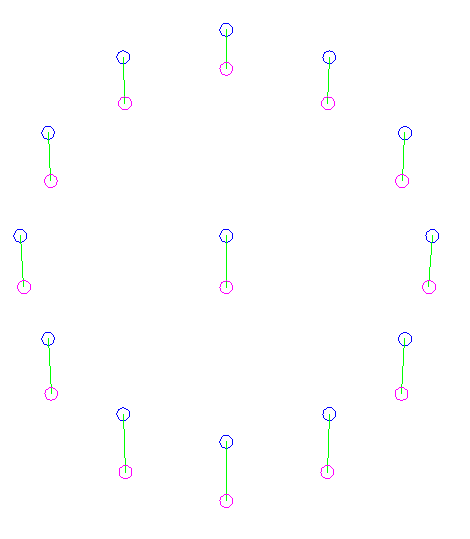
All the mangoes are accelerating towards the star. However, mangoes closer to the star experience a greater gravitational attraction towards the star, and thus accelerate faster towards the star. Similarly, mangoes further away accelerate slower. The end result is that the mangoes fall at different rates, and the circular array starts to deform. The circle stretches into an ellipse.


Apart from the forces’ magnitude, there is also a difference in force directions. The mangoes are all falling towards the centre of the star, but the mangoes are so far apart that they do not fall in parallel paths.

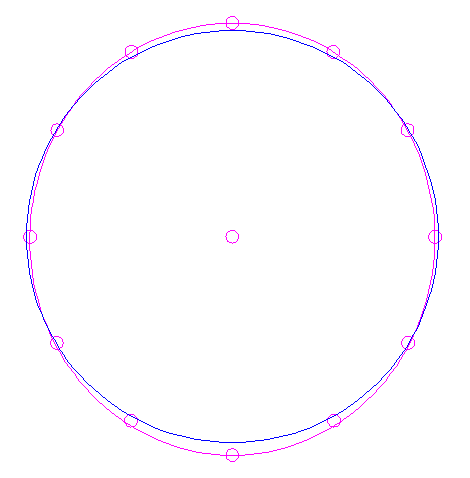
As a result of this converging nature of the free fall paths, the circle also narrows. The illustration shows the mangoes’ position at an interval after the time when they were arranged in the circular layout.

And thus the elliptical shape of the ocean’s tides has partly been explained. A more complete explanation will require that the moon and earth are orbiting each other as opposed to the radial plunge illustrated here using falling mangoes.


Blue curve: circle
Magenta curve: ellipse


Note that the force difference due to the moon is not particularly large; it causes a change in water level of only several metres, considering that the diameter of the earth is 12000 kilometres.

If an unfortunate person were to fall into a smallish black hole, the tidal forces near the singularity would be sufficient to tear the person apart. Parts nearer to the black hole accelerate dramatically faster than parts further away, the difference being sufficient to break the person into pieces.


Method for producing images:

AutoCAD was used to generate the images.
The circular array of mangoes has a radius of 4 units.
The distance between the centre of the array and the star is 60 units.
The distances between individual mangoes and the star were measured using the dimensioning tool
Gravitational attraction is proportional to the inverse of the square, thus this can be calculated from the measured distance.
For convenience, this gravitational force vector’s length was scaled arbitrarily such that the vector of force acting on the centre mango is 1 unit long.
Having determined the vector’s length on each mango, the vectors were drawn using the line tool.
The lines starts at the centre of each mango, and is pointed exactly at the centre of the star, and the line’s length adjusted accordingly.
The displaced positions of the mangoes are arbitrarily placed at the ends of the vector lines. This is acceptable for small time intervals (sufficiently small to neglect changes in gravitational force as the individual mango moves), since displacement s = 0.5at^t, and the displacements are all proportional to the vector lengths.
The final positions of the mangoes are exact, since they are derived as above.
The elliptical trend line is not an exact solution.


,

Labels: ,

Sunday, February 12, 2006

The length scales of the known universe

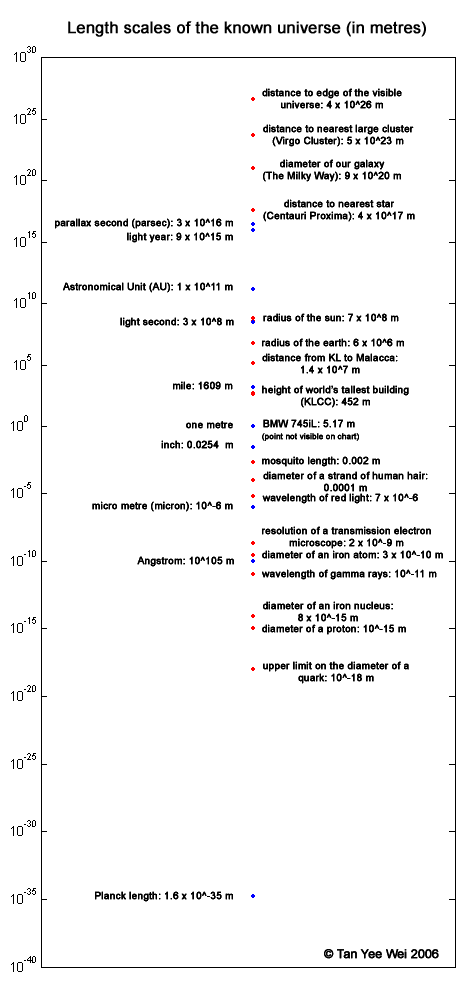
I find it difficult to appreciate the context of sizes involved when I read that the diameter of a proton is 0.000000000000001 metres, or that the diameter of our galaxy is 900000000000000000000 metres.

To ease this little problem, I took representative lengths from various orders of magnitude, sorted them in order, and arranged them on a logarithmic scale axis.

The numbers are written in what some refer to as ‘scientific notation’, where trailing (or leading) zeroes are condensed to a little exponent. For example,
0.0007 = 7 x 10^-4
3,750,000 = 3.75 x 10^6


The blue points correspond to length units other than metres, such as the mile, angstrom and light year. Their text markers are located left of the blue points.

The red points corresponds to lengths of objects, some familiar in our lives, mostly not.


Labels: ,

Wednesday, January 04, 2006

A comparison between Newtonian and Relativistic models of simple oscillating systems

Special relativity will be discussed here, but it is best to learn special relativity from a proper text. While care has been taken to maintain accuracy, many of the important concepts in SR are not well represented here, especially the relativity part: relative to what?

A long time ago, I argued that rigid bodies do not exist. Here is a summary:
A rigid body’s length remains constant all the time. It cannot deform at all. Thus, when one pushes on one end of a rigid rod, the other end also moves at the same time. There is no delay between one end being pushed and the other end moving.

If we have a very long rod, and one end is pushed, at the same time, the other end will move. This process is instant.

However, a beam of light shined from the other end requires finite time to traverse the length of the rod. That being the case, it would seem that by pushing on long rods, information can be sent faster than the speed of light.

Of course, that is impossible. Thus, rigid bodies do not exist. Everything in this universe, from neutron stars to diamond gemstones, are not rigid; they are elastic. All of them.

Related links:
Rigid bodies violate special relativity
Real materials as opposed to rigid bodies

Rigid bodies are objects that have infinite stiffness. The question is, what sort of behaviour will be present when considering materials of large but finite stiffness?

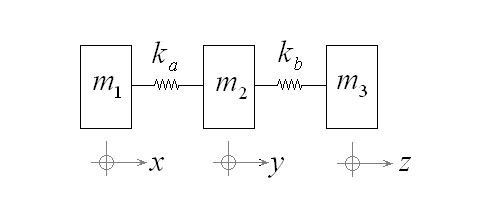
In taking a small step to answering this question, I have constructed a simple model of 3 masses m1, m2 and m3; connected by two linear springs of stiffness ka and kb. In this mathematical model, the coordinates for the individual masses, x, y, and z have their origins at the respective masses’ equilibrium positions.


The differential equations of motion can be easily formulated using the simple F=ma relationship.

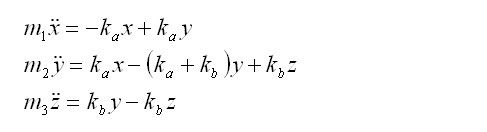
The differential equations for classical Newtonian mechanics are a set of 3 equations as such:


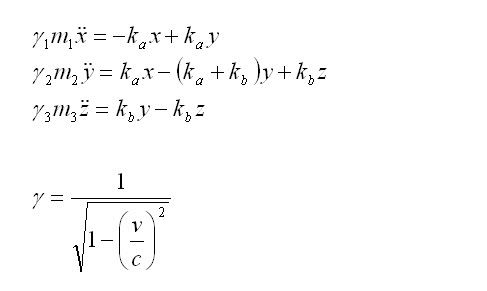
The system is then considered with Relativistic effects. The masses m1, m2 and m3 are called the rest mass, which is the mass measured when the system is stationary. As they move faster and faster approaching the speed of light, the measured mass becomes greater and greater, thus requiring more energy to accelerate. This is accounted for by a term γ that is multiplied with the rest mass.


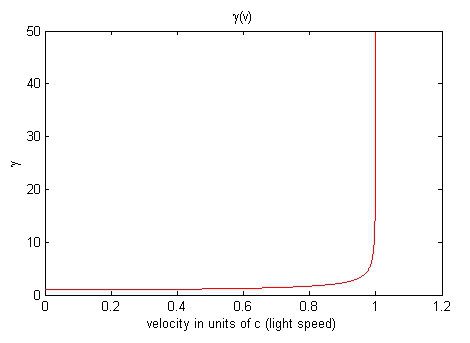
As one can observe from the above equation, when velocity v approaches the speed of light, γ approaches infinity. There is an infinitely high energy barrier that stands at the speed of light. Only massless particles, such as photons, may travel at light speed.

One important effect of γ on the equations of motion is that the mass becomes greater as speeds increase, such that the masses may never approach 300,000 km/s.


Having obtained the differential equations of motion, the motion is then simulated using the 4th order Rungge-Kutta algorithm with increment time intervals of 0.00001s.


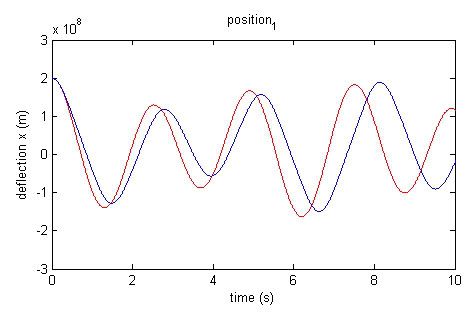
click here for a plot with a larger domain t=[0,20]
red: Newtonian
blue: Relativistic


The plots of the position of mass 1 using Newtonian and relativistic models are not significantly different to the naked eye.


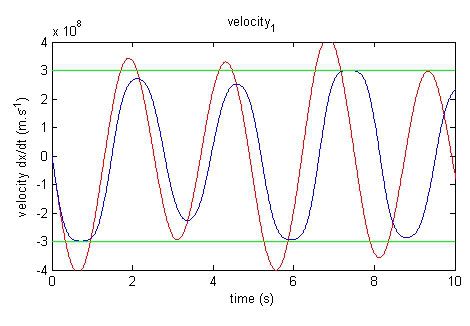
click here for a plot with a larger domain t=[0,20]
red: Newtonian
blue: Relativistic
green: light speed, c


However, the differences are clearly seen when the velocity plots are compared. The linear Newtonian model exhibits instances of violating the speed of light, while the relativistic one shows the energy barrier forbidding the speed to exceed 3x10^8 m/s.

Around the time of 1s, the Newtonian model shows speeds greater than c while the relativistic model remains bounded within c. Referring back to the position plot, this effect can be seen in the slope of the curves. The Newtonian model’s motion is faster, and the slope is thus steeper than the Relativistic model’s.

As a consequence, the frequency of oscillation in the relativistic model is lower than that present in the Newtonian model. Also, due to the nonlinear term γ, the Relativistic model does not exhibit sinusoidal motion.


Labels: , ,